Shop Books

354 books available

To Rob a Bank is an Honor. Lucio Urtubia
Low Stock (4 left)

To Rob a Bank is an Honor. Lucio Urtubia

Paul Sharkey (trans)

For the first time in English, the life story of the revolutionary outlaw who brought Citibank to its knees. In 1981, Lucio Urtubia received a suitcase full of cash from Citibank executives, handed over the plates he'd used to forge 20 million dollars in traveler's checks, and walked away a free man. This is the true story of the most famous Robin Hood of the twentieth century, a lifelong anarchist who robbed from the rich to give to liberation struggles the world round. Born to a poor family in the Basque Country, Urtubia was conscripted into Franco's army at seventeen, where he began smuggling rations from military stores. In 1954, he fled to exile in Paris, where he learned to work as a mason, laying bricks by day and collaborating with Catalonian anarchists by night. Soon, he was planning bank heists to fund the Spanish struggle, stealing weapons, and masterminding the escape of resistance fighters. Following the uprisings of May 1968, Urtubia opened a printshop, producing political pamphlets while amassing a crew of operatives to counterfeit passports, ID cards, and workers' paychecks. By the late 70s, Urtubia hit on the plan that would make him infamous: changing the serial numbers on traveler's checks and depositing them simultaneously. Citibank's early global banking system offered the prime target, and checks spread to revolutionary movements in Europe, Latin America, and the United States. "He who robs a thief is a thousand times forgiven," Urtubia argued. Over decades, Urtubia funneled material support to groups including the Red Brigades in Italy, the Baader-Meinhof group in Germany, the Black Panthers in the US, and the ETA Basque separatists. Told with Urtubia's characteristic warmth and humor, To Rob a Bank Is an Honor collects the adventures and political convictions of this larger-than-life figure of an incendiary era.

£18.00Member: £0.00
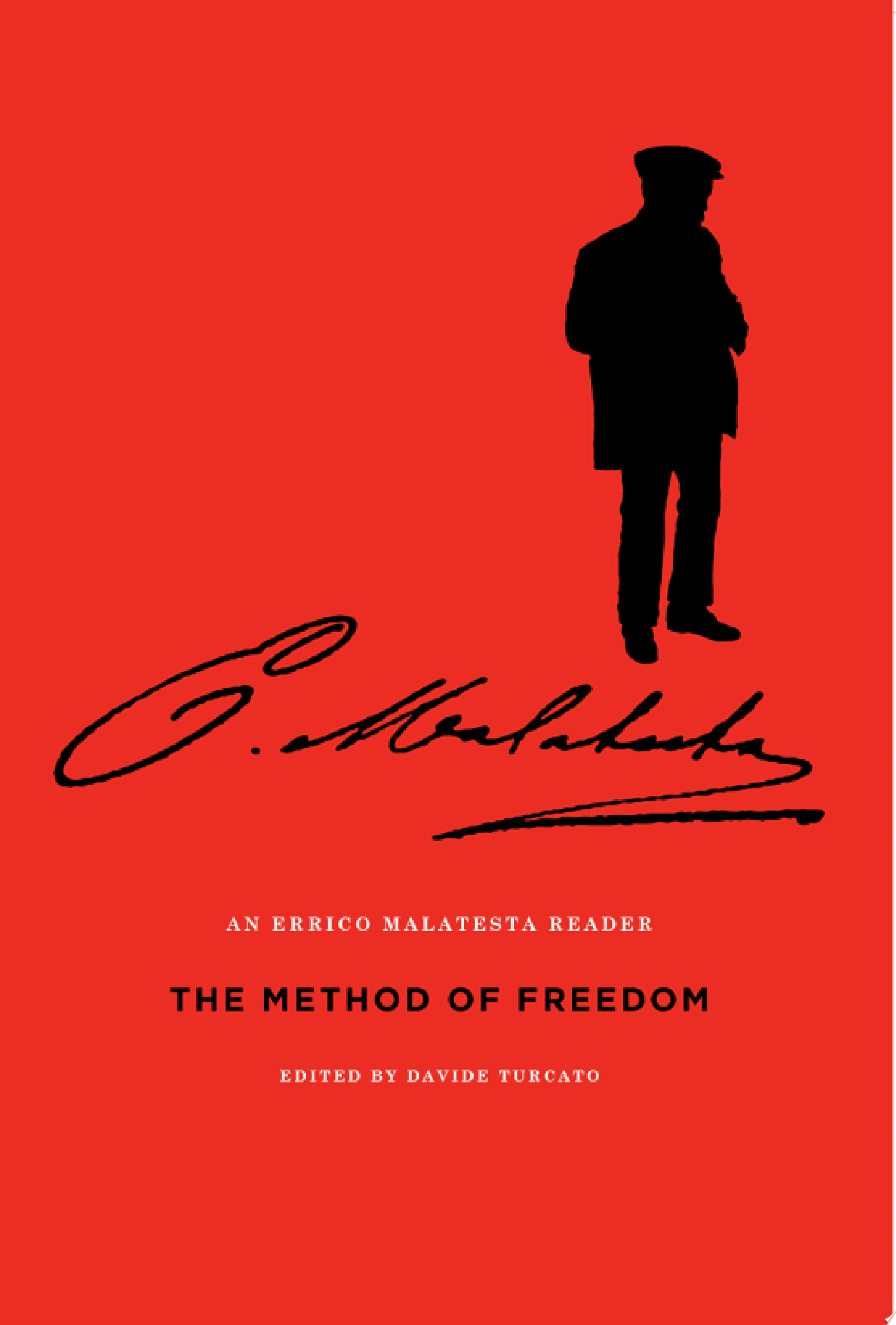
The Method of Freedom. An Errico Malatesta Reader
Low Stock (1 left)

The Method of Freedom. An Errico Malatesta Reader

Errico Malatesta. Davide Turcato (ed). Paul Sharkey (trans)

“Anarchy, in common with socialism, has as its basis, its point of departure, its essential environment, equality of conditions; its beacon is solidarity and freedom is its method.”—Errico Malatesta The most distinctive and universal anarchist principle is the principle of coherence between ends and means: human emancipation cannot be achieved by authoritarian means. However, the same principle could also be read in the opposite direction: our ends should not be disconnected from our action; our ideals should not be so lofty as to make no difference to what we do here and now. The anarchist whose deeds and words have best illustrated both sides of that principle—the “idealist” and the “pragmatist”—is Errico Malatesta. Never one to divorce thought from action, or retreat into dogmatism, his life and ideals remain an inspiration the world over. The Method of Freedom is the first collection to capture the full range of Malatesta’s thought over sixty years as an anarchist propagandist. The Method of Freedom collects Malatesta's most enduring long-form essays--including "Anarchy" and "Our Program"--together with previously untranslated articles from the numerous journals he edited over his long newspaper career. In fact, nearly two-thirds of the collected texts have been newly translated into English. Written in Malatesta's clear, accessible style, these essays are sure to excite a new generation of radicals.

£18.00Member: £0.00
Anarchist Popular Power: Dissident Labor and Armed Struggle in Uruguay 1956-76
Low Stock (1 left)

Anarchist Popular Power: Dissident Labor and Armed Struggle in Uruguay 1956-76

Troy Andreas Ariaza Kokinis

A Cold War-era study of Latin American anarchism in action. Araiza Kokinis's study of the Uruguayan Anarchist Federation (FAU) broadens our understanding of the Cold War-era political landscape beyond the capitalism-communism and Old Left-New Left binaries that dominate the historiography of the epoch. Arguably the most impactful anarchist organization globally in the Cold War era, the FAU viewed everyday people as revolutionary protagonists and sought to develop a popular counter-subjectivity through accumulating experiences directly challenging the market and the state. The FAU argued that everyday people transformed into revolutionary subjects through the regular practice of collective direct action in labor unions, student organizations, and neighborhood councils. Their slogan was "create popular power," and their praxis differed from nationalist strains of Marxism at the time. The strategies and tactics promoted by FAU, ones in which everyday people took on roles as historical protagonists, offered the largest threat to maintaining social order in Uruguay and thus spawned a military takeover of the state to dismantle and deflate their vibrant popular revolt. With less than 80 militants, FAU played a key role both sparking and networking popular protagonism in workplaces, neighborhoods, and on campuses. The FAU worked in coalition with the Communist Party (PCU), MLN-Tupamaros (MLN-T), and other Left organizations to support a unified Left project while simultaneously challenging hegemonic strategies, tactics, and discourses. Unlike other anarchist groups worldwide, which took to individualism and counterculture in response to Marxism's popularity throughout the sixties, the FAU embraced Third Worldism and a class struggle strategy that made them a relevant force amongst popular social movements. Throughout the constitutional dictatorship (1967-73), the Tendencia Combativa, a coalition of dissident labor unions spearheaded by FAU, controlled one-third of the nation's unions in some of the most lucrative industries, especially in the private sector. By the time of June 27, 1973, military coup, a majority of Uruguayan industrialists recognized organized labor as the most serious threat to national security. Moreover, communications between US Ambassador to Uruguay Ernest V. Siracusa and US Secretary of State Henry Kissinger, showed the dictatorship's primary concern was to repress the surging labor movement rather than confronting a waning Tupamaro guerrilla movement. The FAU's anarchist activism within this broader climate of worker revolt threw a wrench in the 1970s neoliberal experiments in Latin America that later migrated north to impoverish American workers from the 1980s until today.

£21.00Member: £0.00
PreviousPage 13 of 15Next