Back to Categories

Anarchism

106 books available

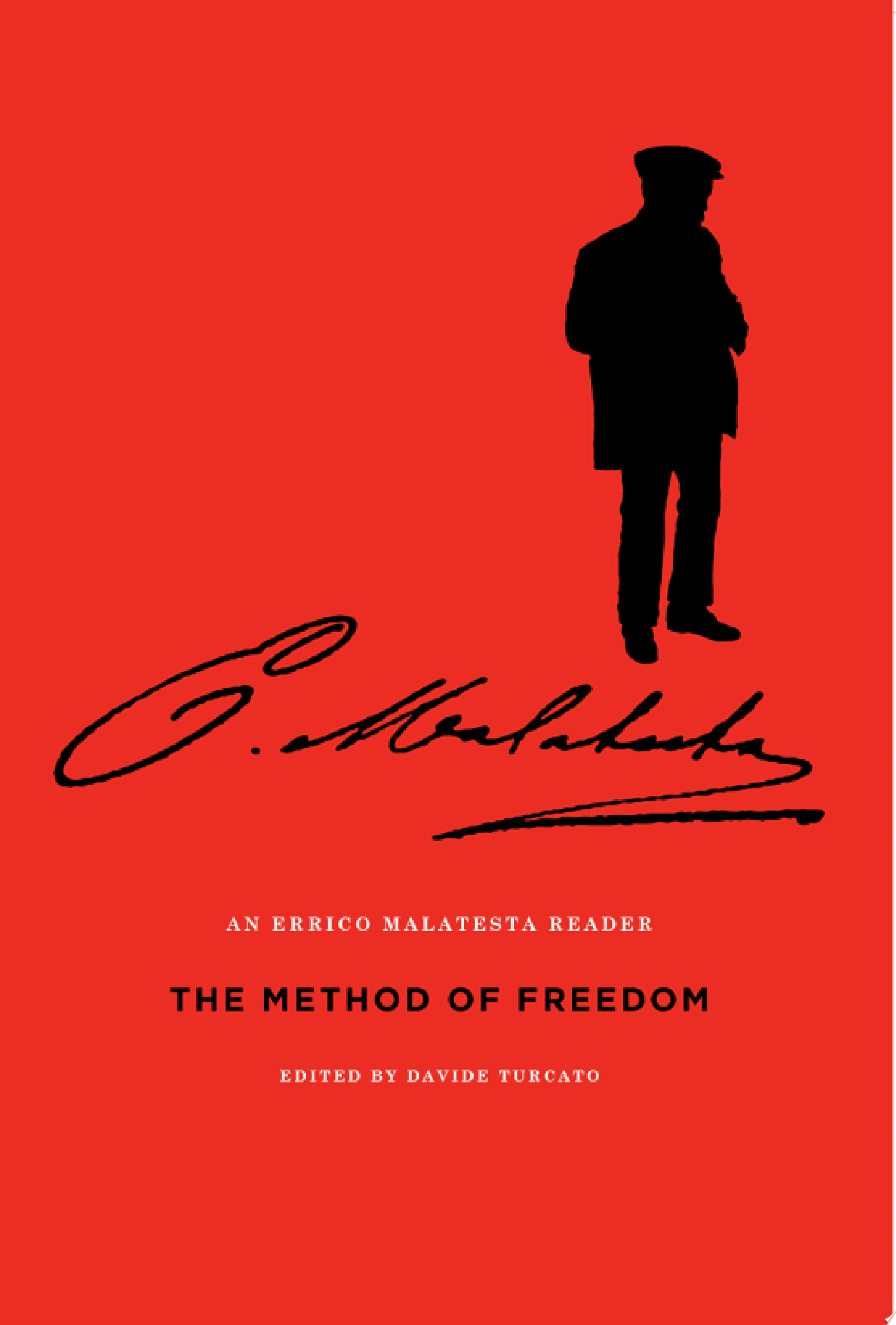
The Method of Freedom. An Errico Malatesta Reader
Low Stock (1 left)

The Method of Freedom. An Errico Malatesta Reader

Errico Malatesta. Davide Turcato (ed). Paul Sharkey (trans)

“Anarchy, in common with socialism, has as its basis, its point of departure, its essential environment, equality of conditions; its beacon is solidarity and freedom is its method.”—Errico Malatesta The most distinctive and universal anarchist principle is the principle of coherence between ends and means: human emancipation cannot be achieved by authoritarian means. However, the same principle could also be read in the opposite direction: our ends should not be disconnected from our action; our ideals should not be so lofty as to make no difference to what we do here and now. The anarchist whose deeds and words have best illustrated both sides of that principle—the “idealist” and the “pragmatist”—is Errico Malatesta. Never one to divorce thought from action, or retreat into dogmatism, his life and ideals remain an inspiration the world over. The Method of Freedom is the first collection to capture the full range of Malatesta’s thought over sixty years as an anarchist propagandist. The Method of Freedom collects Malatesta's most enduring long-form essays--including "Anarchy" and "Our Program"--together with previously untranslated articles from the numerous journals he edited over his long newspaper career. In fact, nearly two-thirds of the collected texts have been newly translated into English. Written in Malatesta's clear, accessible style, these essays are sure to excite a new generation of radicals.

£18.00Member: £0.00
Anarchist Popular Power: Dissident Labor and Armed Struggle in Uruguay 1956-76
Low Stock (1 left)

Anarchist Popular Power: Dissident Labor and Armed Struggle in Uruguay 1956-76

Troy Andreas Ariaza Kokinis

A Cold War-era study of Latin American anarchism in action. Araiza Kokinis's study of the Uruguayan Anarchist Federation (FAU) broadens our understanding of the Cold War-era political landscape beyond the capitalism-communism and Old Left-New Left binaries that dominate the historiography of the epoch. Arguably the most impactful anarchist organization globally in the Cold War era, the FAU viewed everyday people as revolutionary protagonists and sought to develop a popular counter-subjectivity through accumulating experiences directly challenging the market and the state. The FAU argued that everyday people transformed into revolutionary subjects through the regular practice of collective direct action in labor unions, student organizations, and neighborhood councils. Their slogan was "create popular power," and their praxis differed from nationalist strains of Marxism at the time. The strategies and tactics promoted by FAU, ones in which everyday people took on roles as historical protagonists, offered the largest threat to maintaining social order in Uruguay and thus spawned a military takeover of the state to dismantle and deflate their vibrant popular revolt. With less than 80 militants, FAU played a key role both sparking and networking popular protagonism in workplaces, neighborhoods, and on campuses. The FAU worked in coalition with the Communist Party (PCU), MLN-Tupamaros (MLN-T), and other Left organizations to support a unified Left project while simultaneously challenging hegemonic strategies, tactics, and discourses. Unlike other anarchist groups worldwide, which took to individualism and counterculture in response to Marxism's popularity throughout the sixties, the FAU embraced Third Worldism and a class struggle strategy that made them a relevant force amongst popular social movements. Throughout the constitutional dictatorship (1967-73), the Tendencia Combativa, a coalition of dissident labor unions spearheaded by FAU, controlled one-third of the nation's unions in some of the most lucrative industries, especially in the private sector. By the time of June 27, 1973, military coup, a majority of Uruguayan industrialists recognized organized labor as the most serious threat to national security. Moreover, communications between US Ambassador to Uruguay Ernest V. Siracusa and US Secretary of State Henry Kissinger, showed the dictatorship's primary concern was to repress the surging labor movement rather than confronting a waning Tupamaro guerrilla movement. The FAU's anarchist activism within this broader climate of worker revolt threw a wrench in the 1970s neoliberal experiments in Latin America that later migrated north to impoverish American workers from the 1980s until today.

£21.00Member: £0.00
Anarchism and Other Essays
Low Stock (1 left)

Anarchism and Other Essays

Emma Goldman

A true classic of radical literature, in its first scholarly, annotated edition. Emma Goldman, the "notorious anarchist" deported from the United States in 1919 for "seditious activities," was a leading figure of American anarchism for almost thirty years. She continued to write and speak on anarchism for the rest of her life in exile, first in Soviet Russia and then in Europe--including Spain during the Spanish Revolution--and, finally, Canada. Goldman played a pivotal role in the development of anarchism in America and Europe in the first half of the twentieth century. This collection, first published in 1910 by her press, Mother Earth Publishing Association, illustrates her wide-reaching mind and ability to bring together strands of American and European individualism, anarchist communism, and early feminist thinking to develop a body of work that continues to influence the theory and practice of anarchism today. Essays include "Anarchism: What It Really Stands For," "The Psychology of Political Violence," "Prisons: A Social Crime and Failure," "The Hypocrisy of Puritanism," "The Tragedy of Woman's Emancipation," and "Marriage and Love," among others. A new introduction by Moran and Pateman situates Goldman's thinking in the movement of her day but also makes clear why her essays are still vital. Annotations throughout bring to light individuals and events that enrich our understanding of Goldman's writings. The Working Classics Series revives lineages of radical thought from the history of the anarchist movement.

£14.00Member: £0.00
PreviousPage 3 of 5Next